
Residential roofing
Seamless gutters, built for Gulf-region rain
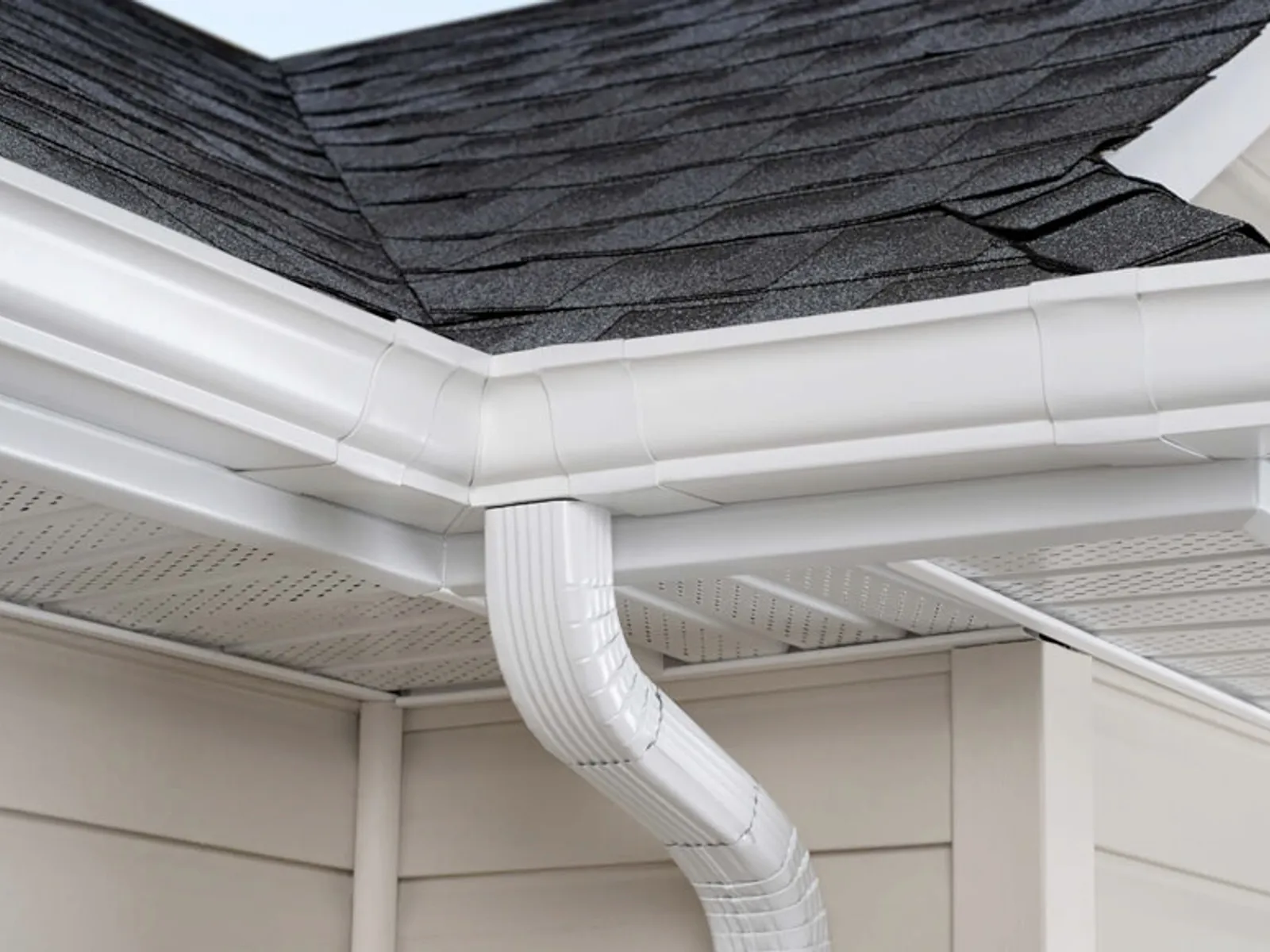
Custom-formed on site in continuous runs, no seams to split, no joints to drip. South Mississippi gets some of the heaviest rainfall in the country, and seamless gutters are what stand between that water and your fascia, walls, and foundation.
 Seamless gutters
The system that protects everything below the roof
A roof sheds water; gutters decide where it goes. When they're undersized, clogged, or pulling away from the fascia, every heavy storm pours water against your eaves, behind your walls, and into the soil at your foundation. In a climate where multi-inch rain days are routine, that adds up to rotted fascia boards, stained brick, washed-out beds, and settlement cracks.
Because we're a roofing company first, we look at gutters as part of the roof system: sized to your actual roof area and pitch, hung with the right fall toward downspouts, and integrated correctly with drip edge and flashing. Replacing your roof? That's the ideal moment to evaluate the gutters too, and we'll give you an honest read on whether yours can stay.
Signs your gutters aren't keeping up
Overflow in heavy rain
Sheets of water over the gutter edge mean undersized or clogged runs.
Sagging or separation
Gutters pulling off the fascia are usually a sign of failed hangers, or rotted wood behind them.
Rot and stains at the eaves
Peeling paint, dark streaks, or soft fascia boards point to chronic overflow.
Trenches in your beds
Erosion lines under the roof edge mean water is bypassing the gutters entirely.
Water at the foundation
Pooling against the slab or crawlspace moisture often traces straight back to gutter failure.
Rust, holes, and split seams
Older gutters fail at the joints first, patching buys time, but not much in our rainfall.
Five-inch or six-inch: sizing to the roof, not habit
Most homes here carry 5-inch K-style gutters, and on modest roof planes that's fine. But South Mississippi rainfall isn't modest. On large planes, steep pitches, and runs that catch a valley's discharge, the step up to 6-inch is often the difference between a system that keeps up and one that sheets over the front edge in every summer downpour.
| 5-inch K-style | 6-inch K-style | |
|---|---|---|
| Capacity | Handles typical roof planes in moderate rain | Meaningfully more water per foot of run |
| Common downspout pairing | 2x3-inch downspouts | 3x4-inch downspouts |
| Best fit | Smaller planes, shallower pitches | Large or steep planes, valley discharge points, heavy tree debris |
| Debris behavior | Clogs faster under pine straw load | More open channel, though guards still earn their keep |
| Relative cost | Lower initial investment | Moderate initial investment |
Downspouts do the heavy lifting
The gutter only holds water, downspouts move it. A 2x3-inch and a 3x4-inch downspout are very different drains, and count and placement matter as much as size. A long run served by one undersized downspout overflows in heavy rain no matter how big the gutter is; upsizing the gutter without fixing the downspouts just builds a bigger bathtub.
We place outlets where water actually concentrates, valley discharge points, the low end of each run, and finish the path to the ground with splash blocks or a clean handoff into underground drainage where the lot needs it.
Roof geometry decides how much water arrives
Two houses with identical gutter footage can put wildly different demands on them. What matters is the roof area draining to each run, how fast the pitch delivers it, and where valleys concentrate it. A valley can aim the collected flow of two planes at a single point on one run, which is why we so often find overflow damage right below one.
Add the local conditions: multi-inch rain days, pine straw matting in the channel and shrinking its capacity, and "standard gutters, standard spacing" stops being a plan. We walk the roof, map where the water goes, and size each run for its actual load.
Slope, hangers, and the edge details that decide everything
Seamless gutters are roll-formed on site in continuous lengths, so the only joints are fabricated ones: outlets, end caps, and corner miters. Each sealed as it's assembled. Every run hangs with consistent fall toward its downspout; a back-pitched gutter holds standing water and rots the fascia behind it.
Runs hang on hidden hangers screwed into solid wood, spaced per the hanger manufacturer's requirements and tightened up in higher-load areas. There's no single universal spacing number. Just as important: sound fascia to bite into, and drip edge or a gutter apron directing water into the channel instead of behind it.
Repair, re-hang, or replace
Not every failing system needs replacing: sound seamless metal that's sagging or back-pitched can be re-hung with corrected fall, and leaking miters resealed. Sectional gutters, short pieces with a seam every few feet, are a different story: each seam is a future drip, and resealing them is a treadmill. Rusted-through or hail-crushed metal earns the honest recommendation: seamless replacement.
Whatever we install, gutters under South Mississippi pines need channels and downspouts checked seasonally, or a leaf guard fitted so the checking mostly goes away.
Our approach
How we approach gutter work
Assess the whole water path
Roof area, valleys, and pitch determine how much water your gutters must move: we size from that, not habit.
Repair or replace honestly
Re-hanging, re-pitching, and resealing can rescue a decent system; we'll tell you when that's enough.
Install with the roof in mind
Correct integration with drip edge and flashing, solid hanger spacing, and downspouts placed to actually move water away.
Leave it working
We water-test the runs, check the fall, and haul off the old material.
Materials & options
Options & add-ons
Every gutter project is configured to your roof, and protected for good if you want it to be.
Seamless K-style runs
Formed on site in continuous lengths, no mid-run seams to split and drip.
Oversized gutters & downspouts
For big or steep roof planes that overwhelm standard sizing in Gulf-region rain.
Leaf guard add-on
Close the system to pine straw and leaves while it stays open to water, and retire the ladder. Ask for it on your gutter quote.
Color-matched finish
Gutter and downspout colors matched to your trim and fascia.
Leaf guard protection can be added to your new gutters in the same visit. It appears as its own line on your itemized proposal, so you decide with the real number in front of you.
What drives the cost of a gutter project
Gutter work is quoted by the project, not a flat rate per house.
Total footage and layout
Linear feet and the number of separate runs, each needing its own slope and outlet.
Gutter and downspout size
5-inch versus 6-inch profiles and 2x3 versus 3x4 downspouts, sized to your roof.
Corners and terminations
Miters, end caps, and outlets are the fabricated, sealed points that take time.
Stories and access
Second-story eaves and tight side yards change ladder work and staging.
Fascia condition
Gutters need solid wood to hang on, soft fascia gets addressed first.
Old system removal
Tear-off and haul-away of the existing gutters, and repair of what they hid.
Drainage handoff
Splash blocks are simple; tying into underground drainage is its own scope.
Leaf guard add-on
Guard protection appears as its own line on the itemized proposal.
Storm damage? We speak insurance.
Thorough documentation, reports in the format adjusters expect, and someone on your side at the adjuster meeting.
How claim assistance works$0 down financing available
Apply through our partner GoodLeap in minutes and see the plans you qualify for, decide with real numbers in hand.
Explore financing optionsLifetime warranty
Manufacturer limited-lifetime warranty options are available on qualifying roofing systems. Ask what applies to your roof at your free inspection.
Start with a free inspectionFAQ
Seamless Gutters questions, answered
Should I replace gutters when I replace my roof?
What size gutters do I need?
Do you repair gutters or only replace them?
Can gutters be damaged by storms like a roof can?
What's the difference between drip edge and a gutter apron?
If seamless gutters have no seams, where can they leak?
Related services
You may also need
Service area
Where we provide seamless gutters
Based in Hattiesburg and serving Mississippi within about two hours, from the Pine Belt to the Gulf Coast.
- Purvis
- Sumrall
- Seminary
- Collins
- Ellisville
- Richton
- Waynesboro
- Leakesville
- Columbia
- Poplarville
- Wiggins
- Perkinston
- Lucedale
- Kiln
- McHenry
- Saucier
- Diamondhead
- Bay St. Louis
- Pass Christian
- Long Beach
- D'Iberville
- Ocean Springs
- Moss Point
- Pascagoula
- Crystal Springs
- Jackson
- Meridian
Don't see your town? If you're within about two hours of Hattiesburg, we most likely serve you.
Ready for a roof you don't have to think about?
Schedule a free inspection or get an instant estimate right now. $0 down financing available through GoodLeap.