
Commercial roofing
TPO Commercial Roofing in Hattiesburg, MS
TPO: today's workhorse flat-roof membrane
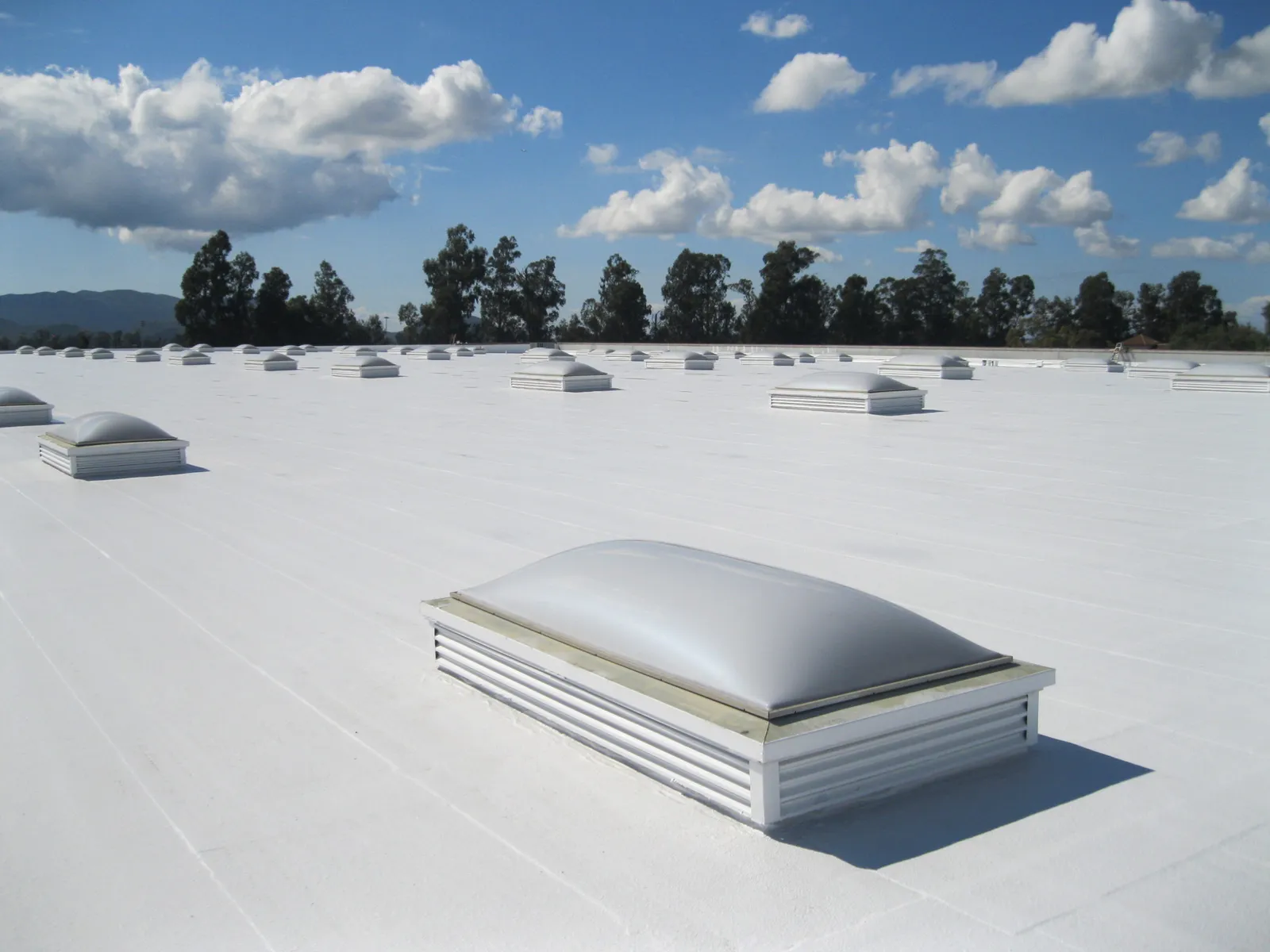
White, reflective, heat-welded single-ply, TPO has become the most installed low-slope system in the country for good reason. We install and service it across South Mississippi's offices, retail, and facilities.
Licensed for commercial roofing in Mississippi
Southeast Roofing LLC holds Mississippi State Board of Contractors Commercial Certificate of Responsibility 27720-SC, alongside residential license R22245. Mississippi requires a commercial license for commercial jobs over $50,000. Below that, local city or county requirements may still apply.
Why TPO dominates low-slope roofing
TPO's appeal is practical: seams are hot-air welded into a single monolithic sheet rather than glued or taped, the white surface reflects the Mississippi sun instead of soaking it in, and the installed cost is competitive with every other membrane on the market. On a building with rooftop HVAC, that reflectivity can take real load off the cooling equipment, though the actual energy effect depends on your insulation, the building, and how it runs.
The system's weak point is the same as its strength, the welds. TPO installed by a crew that rushes the seam work fails years early; TPO welded correctly performs for decades. That's an installation-quality story, which is exactly where a local contractor you can hold accountable matters.
When TPO is the right call
Cooling costs matter
Reflective white membrane can take real load off rooftop units through a Gulf-region summer. The effect depends on insulation and building use.
Replacing an aging membrane
TPO is a natural successor to worn single-ply, mod-bit, or built-up systems.
Budget discipline
Competitive installed cost with a long expected service life: a defensible line item for any board.
Serviceable for decades
Welded repairs and tie-ins keep a TPO roof maintainable deep into its life.
45, 60, or 80 mil: picking a thickness
TPO membrane is sold in nominal thicknesses, most commonly 45, 60, and 80 mil (a mil is one thousandth of an inch, so 60 mil is a little over a sixteenth of an inch). Thicker sheet means more material over the internal reinforcement, more weathering allowance and more resistance to scuffs and punctures, at a higher material price. Nominal values and exact constructions vary by manufacturer, which is why the proposal names the specific product.
For most South Mississippi commercial buildings, 60 mil has become a common specification: enough thickness margin for a realistic service life without paying for capability the roof will never use. 45 mil suits budget-driven projects with low rooftop traffic; 80 mil earns its premium on roofs with heavy equipment service or where the owner wants the longest available warranty terms.
| Nominal thickness | Where it's commonly specified | Typical attachment options | Considerations |
|---|---|---|---|
| 45 mil | Budget-conscious projects, low rooftop traffic | Mechanically attached; fully adhered | Thinnest weathering allowance; shortest warranty terms commonly offered |
| 60 mil | The common commercial spec for offices, retail, warehouses | Mechanically attached; fully adhered; induction-welded | Balanced thickness, availability, and warranty options |
| 80 mil | High-traffic roofs, long warranty terms, demanding owners | Fully adhered; mechanically attached; induction-welded | Highest material cost; greatest puncture and weathering margin |
What's actually inside the sheet
TPO is a reinforced thermoplastic: two layers of polymer sandwiching a fabric reinforcement (a scrim) that gives the sheet its tear strength and dimensional stability. The top layer carries the weathering package: the UV stabilizers and pigments that determine how the membrane ages under a Gulf-region sun.
Like every membrane, TPO needs a continuous substrate underneath: insulation boards and, on better assemblies, a cover board between insulation and membrane that stiffens the surface against hail, dropped tools, and foot traffic. No membrane spans open framing; the boards below the sheet are separate assembly components, and they matter as much as the membrane itself.
Hot-air welding, where TPO roofs are won or lost
TPO seams are fused with hot air: a machine or hand welder heats both sheets until the thermoplastic surfaces melt together under pressure, creating a bond that becomes part of the membrane rather than a glued joint on top of it. Done right, the seam is as strong as the sheet.
Weld quality depends on temperature, machine speed, pressure, the condition of the membrane surfaces, the weather during welding, and the technician running the equipment, which is why we probe and check completed seams following the manufacturer's procedures as the work progresses, not after the crew has left. A weld that looked fine from ten feet away is exactly the kind of defect that surfaces as a leak three years later.
Mechanically attached, fully adhered, or induction-welded
Mechanically attached TPO is fastened through the membrane into the deck along seam rows: fast, economical, and the most common method on wide-open roofs. Fully adhered TPO is glued continuously to the substrate, which eliminates fastener rows in the field, lays flatter, and can suit buildings where membrane flutter or interior air pressure is a concern. Induction-welded systems bond the membrane to specially coated fastener plates with an electromagnetic tool, fasteners hold the sheet without penetrating it.
Which method fits depends on the deck type, wind-uplift requirements for the building's zone, the insulation package, and the manufacturer's approved assemblies. There is no universally better answer; there is a right answer for your building, and the proposal explains the reasoning.
Recover or tear-off for an existing roof
Where the existing assembly is dry and sound, a recover, new insulation or cover board and new TPO over the old roof, avoids tear-off cost, disposal, and days of open-roof exposure. Where moisture testing finds saturated insulation, or code limits on the number of roof layers have been reached, tear-off is the honest answer. We take core samples before recommending either path, because recovering a wet roof just buries a problem you will pay to dig up later.
One more honest note: drainage rules don't change with a new membrane. Low-slope roofs need positive drainage, roughly a quarter inch per foot is commonly targeted where practical, and ponding water is never harmless to any membrane, TPO included. If your roof holds water, the replacement design should address why.
TPO against EPDM and PVC
Against EPDM, TPO trades a rubber sheet's long track record and large-panel simplicity for welded seams and a reflective white surface. Against PVC, TPO gives up some chemical resistance, kitchens and grease exposure favor PVC, in exchange for a lower material cost. Note that TPO and PVC cannot be welded to each other; the chemistries are incompatible, which matters for repairs and tie-ins.
And a caution on rooftop traffic: TPO is not puncture-immune. Dropped tools, HVAC panel screws, and trades walking the same path to a unit will eventually find a thin spot. Walk pads around serviced equipment are cheap insurance we spec on nearly every TPO roof.
Our approach
How we install TPO
Assessment & core checks
We evaluate the existing assembly, insulation, and decking: recover and full-replacement options priced honestly.
Spec and proposal
Membrane thickness, attachment method, insulation package, and details: written out, itemized, no mystery.
Installation around operations
Staging, access, and noisy phases scheduled with your team so the building keeps working.
Seam quality control
Welds probed and checked per the manufacturer's procedures as we go: the detail that decides how the roof ages.
What determines your TPO proposal?
No two TPO projects price the same, because the membrane is only one line item. These are the factors that actually move the number:
Membrane thickness and product line
45, 60, or 80 mil, and the specific manufacturer's product, which sets warranty options.
Recover vs. tear-off
Whether the existing assembly can stay (verified by core samples) or must come off and be disposed of.
Insulation and cover board package
Target R-value, tapered insulation for drainage, and whether a cover board is specified.
Attachment method
Mechanically attached, fully adhered, or induction-welded: driven by deck type and wind-uplift requirements.
Detail density
Every curb, penetration, drain, and wall termination is hand work, equipment-crowded roofs take far more labor than wide-open ones.
Edge metal and terminations
Perimeter metal, coping, and gutter work are their own scope, often custom-fabricated.
Access and staging
Crane or lift needs, material loading paths, and how much protection your operations require.
Warranty term
Longer manufacturer terms typically require specific assemblies, thicknesses, and inspections.
FAQ
TPO Roofing questions, answered
How long does a TPO roof last?
Can TPO be installed over our existing roof?
Is 60 mil really worth it over 45 mil?
Does white TPO actually lower our cooling bills?
TPO vs. EPDM, which should we choose?
How do you verify the seams are good?
Will the installation disrupt our operations?
Industries we serve
Built for your kind of building
Every facility type has its own schedule, budget, and roof. We roof them all across South Mississippi.
Service area
Where we provide tpo roofing
Based in Hattiesburg, on commercial buildings across the Pine Belt, the Gulf Coast and the corridor between them.
We work well beyond these eight, on a radius of about two hours from Hattiesburg. See every town we serve, or tell us where the building is.
Let's talk about your roof
A consultation, not a sales pitch: we assess your building, your operations, and your budget cycle, then propose the system that actually fits.