
Commercial roofing
EPDM Commercial Roofing in Hattiesburg, MS
EPDM: the membrane with a 50-year track record
Synthetic rubber that's been protecting flat roofs since the 1960s. Simple, flexible, proven: EPDM remains one of the most dependable low-slope systems money can buy.
Licensed for commercial roofing in Mississippi
Southeast Roofing LLC holds Mississippi State Board of Contractors Commercial Certificate of Responsibility 27720-SC, alongside residential license R22245. Mississippi requires a commercial license for commercial jobs over $50,000. Below that, local city or county requirements may still apply.
Simplicity that ages well
EPDM is a thermoset, a synthetic rubber that's cured into its final state at the factory, unlike thermoplastics such as TPO that soften with heat. It comes off the truck in very large panels, stays flexible through decades of thermal cycling (Mississippi's daily heat swings barely bother it), and repairs, when eventually needed, are straightforward with compatible materials.
That said, no membrane runs itself. An EPDM roof still lives or dies on its seams, flashings, terminations, penetrations, drainage, and the substrate underneath. The field rubber is rarely what fails. Classic EPDM is black and absorbs heat, which suits some buildings and penalizes others; white-faced options exist where reflectivity matters, and we'll tell you plainly which your building wants.
When EPDM makes sense
You want a long service horizon
Well-installed EPDM commonly delivers among the longest planning ranges of any membrane: with maintenance.
Large, open roof areas
Huge sheet sizes mean fewer seams on warehouses and big rectangular roofs.
Repair simplicity matters
Patches and detail repairs with compatible materials are quick and reliable: good for long ownership horizons.
Storm resilience
Flexible membrane handles building movement and debris impact gracefully.
Rubber comes in thicknesses too
EPDM is manufactured in nominal thicknesses that commonly include 45, 60, 75, and 90 mil, a mil being a thousandth of an inch, with 60 mil a frequent commercial choice. Because the sheet is unreinforced rubber in its standard form, extra thickness buys weathering allowance and puncture margin directly; reinforced versions exist for specific applications. Exact offerings vary by manufacturer, and the proposal names the product.
Thicker sheet costs more but is a small fraction of the total project once labor and insulation are counted, so on long-hold buildings we often find the step up from 45 to 60 mil an easy case to make. Beyond that, roof traffic and warranty goals drive the decision.
The big-sheet advantage
EPDM's signature trait is panel size: sheets far larger than anything a thermoplastic roll can offer, which means dramatically fewer field seams on open roof areas. On a big rectangular warehouse, most of the roof can be covered with a handful of panels, and every seam that doesn't exist is a seam that can never fail.
The advantage shrinks on cut-up roofs. A roof crowded with curbs, penetrations, and elevation changes forces the big sheets to be cut and detailed anyway, at which point other systems compete more closely. Roof geometry, not brand preference, should pick the membrane.
Seams by primer and tape: not by welder
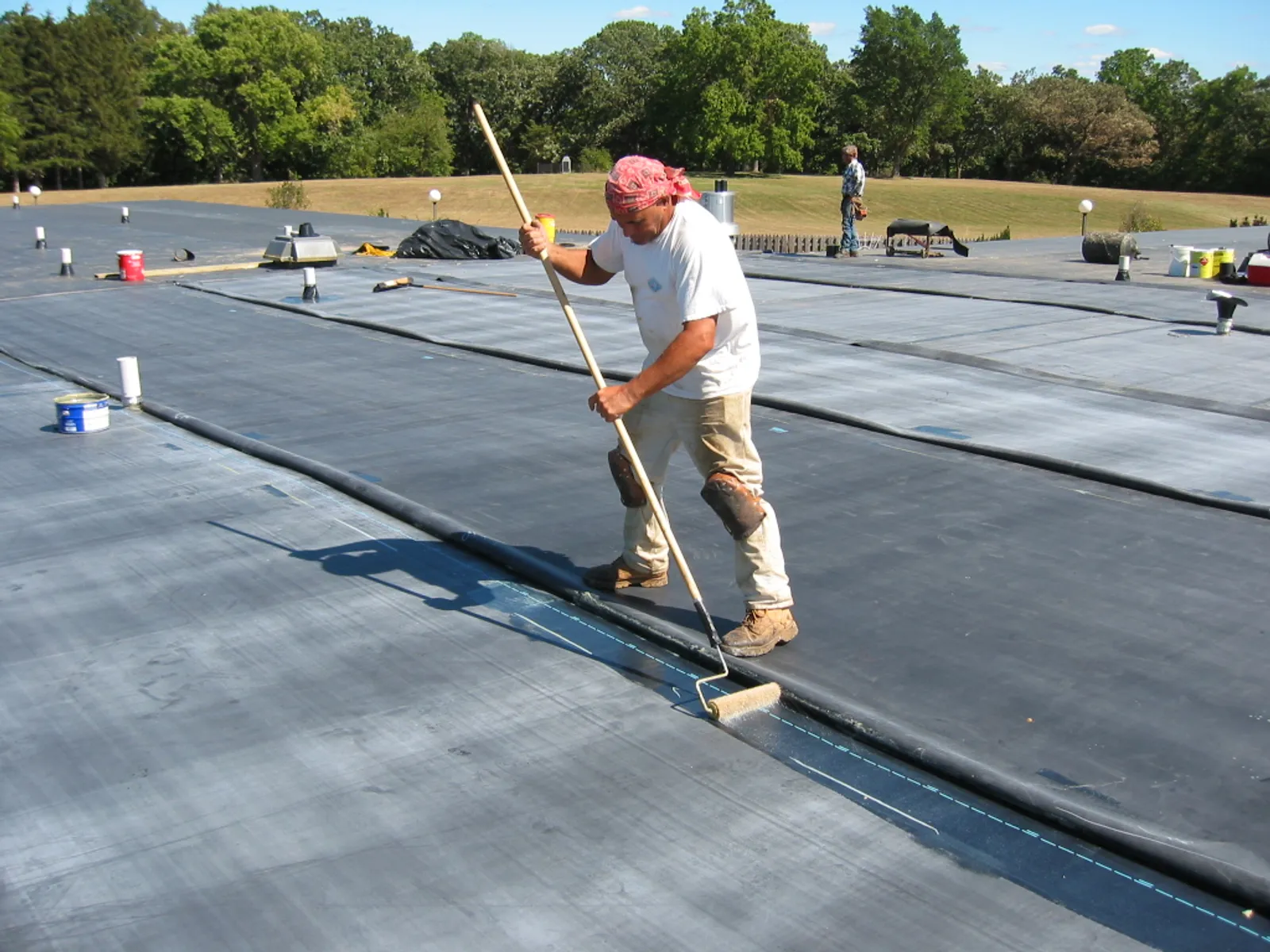
Because EPDM is a cured rubber, its seams can't be hot-air welded the way TPO or PVC seams are. Instead, seam areas are cleaned, primed, and joined with pressure-sensitive seam tape, a system that modern practice has made far more reliable than the field-glued seams of decades past. Preparation is everything: a seam taped over a dusty or unprimed surface is a seam waiting to open.
This distinction matters most at repair time. Anyone showing up to 'weld' an EPDM roof doesn't understand the system, and patches need EPDM-compatible primers and materials: one reason we identify the membrane before any repair, on any roof.
Three ways to hold the rubber down
EPDM can be fully adhered to the substrate, mechanically attached with fasteners and plates, or ballasted, laid loose and weighed down with rounded stone or pavers. Each has a legitimate place, and the table below is the honest overview.
A caution on ballast: it isn't for every building. The structure must carry the added weight, and the perimeter and corner zones need analysis against wind, decisions that involve structural review, not rules of thumb. Where ballast fits, it's economical and protects the membrane from sun and traffic; where it doesn't, forcing it is a mistake.
| Method | How it works | Strengths | Watch-outs |
|---|---|---|---|
| Fully adhered | Membrane glued continuously to the substrate | Lays flat, no fastener rows, suits visible or irregular roofs | Substrate must be clean, dry, and adhesive-compatible |
| Mechanically attached | Fasteners and plates secure the sheet along rows | Fast, economical, works over many deck types | Fastener pattern must match the building's wind-uplift requirements |
| Ballasted | Loose-laid membrane held down by stone or pavers | Economical on qualifying buildings; ballast shields the rubber | Requires structural capacity and perimeter wind analysis: not universal |
Black rubber, white rubber, and the heat question
Standard EPDM is black, and a black roof absorbs more solar heat than a white one: how much that costs you depends on your insulation, the building's use, and how the HVAC runs. On a heavily insulated warehouse, the color of the membrane may barely register in the utility bill; on a marginally insulated office with rooftop units, it can matter.
White-faced EPDM exists for buildings where reflectivity is the priority, and sometimes the honest answer is that a reflective thermoplastic fits better. We'll put the options side by side rather than defending a favorite. Whatever the color, low-slope drainage rules hold: water should leave the roof, roughly a quarter inch of fall per foot is a common design target where practical, because ponding degrades every membrane ever made.
What EPDM doesn't tolerate
Standard EPDM has a real chemical blind spot: oils, grease, and certain solvents attack the rubber. A kitchen exhaust fan discharging onto an EPDM roof will damage it, that exposure belongs on a different membrane. If your building has restaurant tenants or rooftop chemical discharge, say so during the assessment; it changes the recommendation.
Inside its lane, EPDM is one of the most repairable systems in the industry: flexible into old age and patchable with compatible primers and materials, which is why well-detailed EPDM roofs remain serviceable long after their installers have retired. Pair the membrane with scheduled inspections and it's a genuinely low-drama asset.
Our approach
How we install EPDM
Assembly evaluation
Deck condition, insulation value, and drainage reviewed before any system is proposed.
Attachment method to suit the building
Fully adhered, mechanically fastened, or ballasted. Each has its place; we spec what fits yours.
Detail-first installation
Penetrations, edges, and drains get the careful work, field membrane is the easy part.
Documentation & maintenance plan
As-installed photos and a maintenance schedule that protects your investment.
Factors that shape an EPDM project's price
EPDM proposals are built from the roof up, and these are the variables that actually move the total:
Sheet thickness
45, 60, 75, or 90 mil, thicker rubber carries more weathering and puncture margin at higher material cost.
Panel layout and seam count
Open roofs use EPDM's big sheets efficiently; cut-up roofs need more cutting, seaming, and detail labor.
Attachment method
Adhered, mechanically attached, or ballasted, ballast adds structural review to the scope where it's considered.
Existing roof disposition
Recover over a dry, sound assembly versus tear-off and disposal, cores decide, not guesses.
Insulation package
Target R-value, tapered drainage design, and cover board selection.
Flashing and termination details
Walls, curbs, drains, and penetrations are the labor-intensive part of any rubber roof.
Access and logistics
Roof height, staging space, and how carefully work must move around your operations.
FAQ
EPDM Roofing questions, answered
Is EPDM outdated compared to TPO?
Does black EPDM make the building hotter?
How are EPDM seams made if they can't be welded?
Can a ballasted EPDM roof go on any building?
Will grease from our kitchen exhaust hurt an EPDM roof?
Can you repair our existing EPDM roof instead of replacing it?
Industries we serve
Built for your kind of building
Every facility type has its own schedule, budget, and roof. We roof them all across South Mississippi.
Service area
Where we provide epdm roofing
Based in Hattiesburg, on commercial buildings across the Pine Belt, the Gulf Coast and the corridor between them.
We work well beyond these eight, on a radius of about two hours from Hattiesburg. See every town we serve, or tell us where the building is.
Let's talk about your roof
A consultation, not a sales pitch: we assess your building, your operations, and your budget cycle, then propose the system that actually fits.