
Residential exterior
Gutter Leaf Guards in Hattiesburg, MS
Leaf guards: retire the ladder
Pine straw is the great gutter-killer of South Mississippi: it mats, clogs, and sends rain pouring over the edges. A quality leaf guard keeps the water path open year-round without the twice-a-year ladder ritual.
Why gutter protection earns its keep here
Between the pines and the oaks, South Mississippi gutters fill faster than almost anywhere, and a clogged gutter isn't a cosmetic problem. Overflow rots fascia boards, stains siding, floods beds, and dumps water at the slab. The homeowner's alternative is climbing a ladder several times a year, which is exactly how a lot of ER visits start.
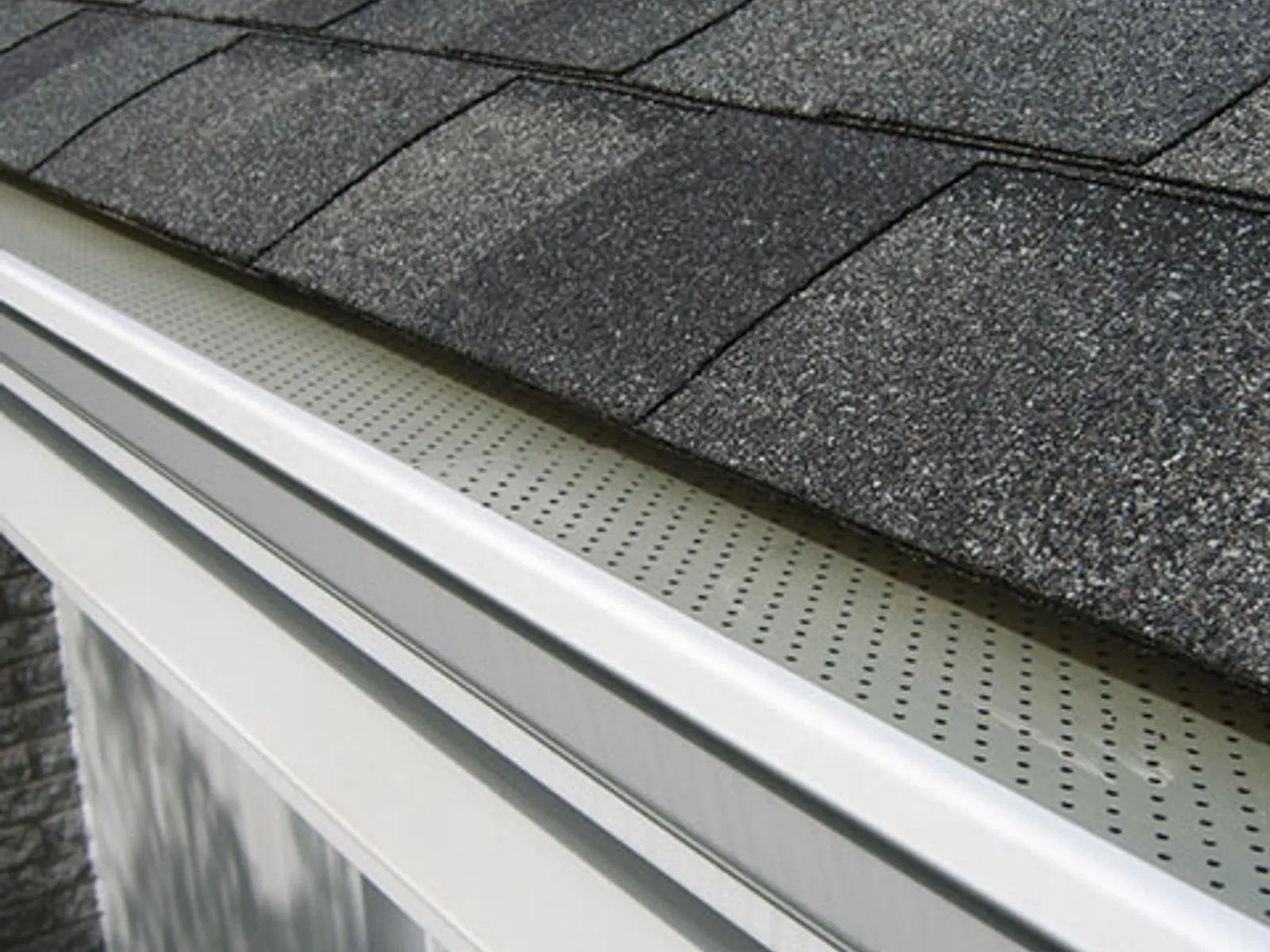
Leaf guards close the top of the gutter to debris while keeping it open to water. Installed correctly: pitched with the gutter, sealed at the roofline, matched to your gutter profile. They turn gutters into a system you simply stop thinking about. We install them on new seamless gutters or retrofit them to sound existing ones.
Signs leaf guards belong on your home
Trees over the roofline
Pines and oaks overhead mean gutters that clog every season, guaranteed.
Overflow after storms
Water sheeting over the gutter edge while the downspouts run dry: that's a clog talking.
The ladder ritual
If you're cleaning gutters more than once a year, guards remove a recurring chore, and a recurring fall risk.
Fascia stains and rot
Chronic overflow shows up as peeling paint and soft boards at the roof edge.
The five families of gutter protection
"Leaf guard" covers five genuinely different product families, and they don't perform alike: especially under pine straw:
| Guard type | Debris performance | Heavy-rain behavior | Maintenance | Visibility | Best use | Main drawback |
|---|---|---|---|---|---|---|
| Perforated metal screen | Stops leaves; needles can enter or mat on top | Handles high flow well | Periodic brush-off and flush | Low profile | Oak-leaf yards on a budget | Pine straw threads through or bridges the openings |
| Expanded-metal screen | Stops most leaves; openings admit fine debris | Good flow capacity | Brush-off; occasional lift-and-clean | Low profile | Mixed hardwood debris | Needles lodge in the mesh pattern |
| Micro-mesh | Blocks needles, shingle granules, and seed pods | Very good when clean; pollen film can shed water until rinsed | Surface rinse or soft-brush as needed | Low profile | Heavy pine straw. The usual pick here | Higher initial investment; quality varies widely by brand |
| Solid surface-tension cover | Sheds most debris off the nose | Can overshoot in intense downpours, especially on steep roofs | Occasional nose cleaning | Most visible from the ground | Heavy leaf load on moderate pitches | Overshoot in Gulf-intensity rain; fit is pitch-sensitive |
| Foam or brush inserts | Debris collects on top and works in | Reduces the gutter's own capacity | Frequent cleaning; degrades in UV | Invisible | Short-term stopgap only | Clogs, breaks down, hides problems. We don't recommend them |
Pine straw is the entrance exam
Most guards are designed around broad leaves, and broad leaves are the easy problem. They sit on top and blow off. Pine needles are the local test: thin enough to thread through screen openings, prone to matting into a thatch that bridges over a guard, and dropped for much of the year. Add shingle granules washing off in every rain and seed pods in spring, and fine-opening protection stops being a luxury.
Valleys concentrate the problem: two roof planes' debris and water arrive at one short stretch of gutter, so that's where bridging starts and overflow shows first. On homes with big valleys over gutter runs, guard choice and fastening in that zone get special attention.
Heavy rain: the other half of the test
A guard that stops needles but can't swallow a Gulf downpour just relocates the overflow. Fine mesh sheds water well when clean, but a film of pollen or granule dust can make water skate over it until rinsed. An honest maintenance point the brochures skip. Solid covers carry a different risk: at high rain intensity, especially on steep pitches and below valleys, water can overshoot the nose entirely.
And no guard adds capacity. If the gutter is undersized or the downspouts can't drain what arrives, a guard won't fix the overflow: we evaluate the gutter system first, the guard second.
What guards don't do
No guard eliminates maintenance entirely, anyone saying otherwise is selling, not advising. The honest expectation: climbing and scooping ends, replaced by an occasional visual check and surface brush-off in heavy pine areas, plus an eye on downspouts and underground drains, which can still collect what slips past over the years.
Also worth knowing: some guard designs install by sliding under the first course of shingles. Lifting the roof edge can raise concerns with the shingle manufacturer's requirements and wind performance, so we prefer designs that fasten to the gutter and fascia without disturbing the shingles: especially on newer roofs with registered warranty coverage.
Healthy gutters first: always
A guard is a lid, and a lid on a failing system locks the failure in. We never install guards over gutters that are back-pitched, rusted through, or pulling loose, and never over rotten fascia. The fix starts below, or the guard money is wasted. Size matters too: a guard has to match the profile of the gutter it protects.
That's the advantage of a roofing company over a guard-only franchise: we check shingle edge, drip edge, fascia, and gutters as one system, fix what's actually wrong, and only then close the top.
Our approach
How we install leaf guards
Gutter health check
Guards on failing gutters waste money. We verify pitch, hangers, and seams first.
Match the guard to the debris
Pine straw demands finer protection than oak leaves: we spec for what your trees actually drop.
Sealed, pitched installation
Fitted to your gutter profile and roofline so water in, debris out, nothing trapped between.
Water test and walkaround
We verify flow at every downspout before we leave.
Why leaf guard quotes are home-specific
Guard pricing follows the house, not a per-foot sticker. Here's what we look at before quoting.
Guard family selected
Micro-mesh, screen, and surface-tension products sit at different price points and suit different debris loads.
Linear footage and runs
Total gutter length and how it's broken into separate runs and corners.
Stories and access
Second-story eaves and steep terrain change the ladder and staging work.
Existing gutter condition
Re-pitching, resealing, or replacing runs comes first, guards only go on gutters worth protecting.
Roof pitch
Steeper roofs deliver water faster and narrow the guard choices that behave well.
Valleys and corners
Valley discharge zones and miters need extra attention and sometimes different detailing.
Storm damage? We speak insurance.
Thorough documentation, reports in the format adjusters expect, and someone on your side at the adjuster meeting.
How claim assistance works$0 down financing available
Apply through our partner GoodLeap in minutes and see the plans you qualify for, decide with real numbers in hand.
Explore financing optionsLifetime warranty
Manufacturer limited-lifetime warranty options are available on qualifying roofing systems. Ask what applies to your roof at your free inspection.
Start with a free inspectionFAQ
Leaf Guard Systems questions, answered
Do leaf guards really work with pine straw?
Can you add guards to my existing gutters?
Do I ever have to clean them?
Which gutter guard type is best?
Will a guard affect my shingle warranty?
Can leaf guards handle our downpours?
Service area
Where we provide leaf guard systems
Based in Hattiesburg and serving Mississippi within about two hours, from the Pine Belt to the Gulf Coast.
- Purvis
- Sumrall
- Seminary
- Collins
- Ellisville
- Richton
- Waynesboro
- Leakesville
- Columbia
- Poplarville
- Wiggins
- Perkinston
- Lucedale
- Kiln
- McHenry
- Saucier
- Diamondhead
- Bay St. Louis
- Pass Christian
- Long Beach
- D'Iberville
- Ocean Springs
- Moss Point
- Pascagoula
- Crystal Springs
- Jackson
- Meridian
Don't see your town? If you're within about two hours of Hattiesburg, we most likely serve you.
Ready for a roof you don't have to think about?
Schedule a free inspection or get an instant estimate right now. $0 down financing available through GoodLeap.