
Commercial roofing
Commercial Roof Maintenance in Hattiesburg, MS
The least expensive roof work is the scheduled kind
Commercial roofs rarely fail suddenly. They fail slowly, visibly, and preventably. A maintenance program catches the minor defect before it becomes the capital emergency.
Licensed for commercial roofing in Mississippi
Southeast Roofing LLC holds Mississippi State Board of Contractors Commercial Certificate of Responsibility 27720-SC, alongside residential license R22245. Mississippi requires a commercial license for commercial jobs over $50,000. Below that, local city or county requirements may still apply.
Why planned maintenance is the best roofing spend
Nearly every commercial roof disaster we're called to started as something small: a clogged drain ponding water, a split pitch pan, a fastener backing out under a seam. Caught on a scheduled inspection, each is a minor line item. Discovered after a tropical rain event has flooded a server room, the same defect is a capital emergency plus interior damage plus downtime.
A program also protects paperwork: manufacturer warranties on commercial systems generally expect documented maintenance, and the inspection record we build becomes the evidence that distinguishes new storm damage from old wear when a claim is filed. One honest limit up front: maintenance doesn't stop a roof from aging; it removes the avoidable damage that ages roofs early, and it converts surprises into scheduled decisions.
What a program visit covers
Full-surface inspection
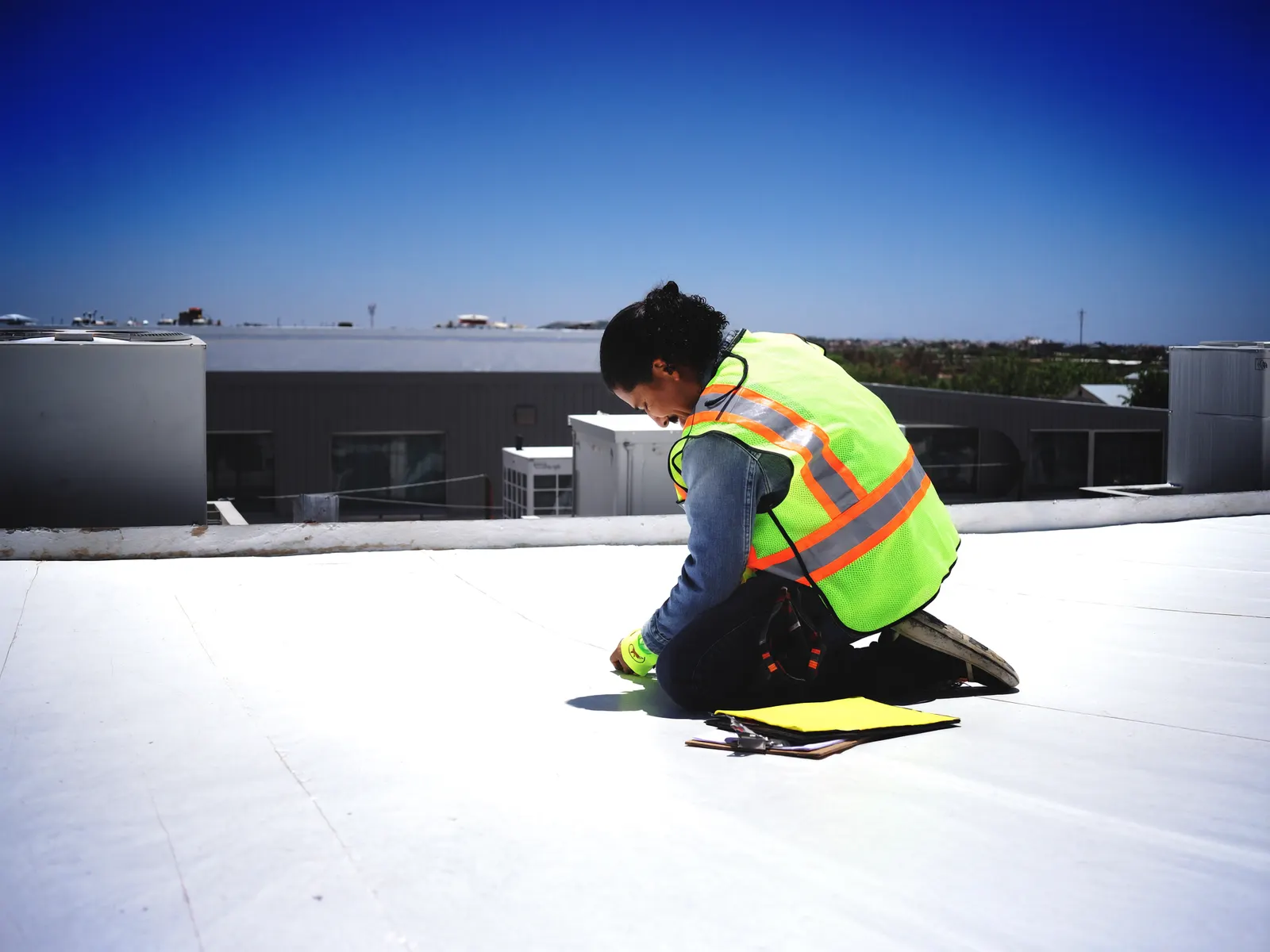
Membrane, seams, flashings, and penetrations: walked and photographed on schedule.
Drainage service
Drains, scuppers, and gutters cleared, ponding is the quiet killer of flat roofs.
Small repairs on the spot
Minor seam, sealant, and detail fixes handled during the visit, not quoted for later.
Condition report
Photo documentation and a straight-language condition summary after every visit.
What a program visit actually inspects
A maintenance visit isn't a walk with a clipboard. It's a systematic pass over every component that fails on commercial roofs, with photos and small fixes as we go. The matrix below is the realistic scope on a typical low-slope building; metal roofs swap in fastener and seam checks appropriate to their system.
| Item | What is checked | Typical failure | Recommended response | Responsible party |
|---|---|---|---|---|
| Drains & scuppers | Blockage, strainer condition, ponding evidence | Debris clogs causing standing water | Clear on the spot; flag chronic ponding for drainage review | Roofing contractor |
| Field membrane & seams | Splits, punctures, seam edges, blisters | Trade damage, seam fatigue, weathering | Small membrane-matched repairs; monitor marginal areas | Roofing contractor |
| Flashings & terminations | Wall, curb, and edge-metal attachment and sealant | Sealant aging out; flashing pulling away | Reseal or re-secure; schedule rework if recurring | Roofing contractor |
| Pitch pockets & penetrations | Filler level and cracking at sealed penetrations | Dried, shrunken filler opening a leak path | Top off or rebuild the pocket | Roofing contractor |
| RTU curbs & equipment | Curb flashing, panel screws, condensate routing | HVAC service damage; condensate dumping on membrane | Repair flashing; coordinate with HVAC vendor | Contractor + HVAC vendor |
| Walk pads & traffic routes | Pad condition and coverage of actual service paths | Traffic wearing membrane off-pad | Add or relocate pads to match real routes | Roofing contractor |
| Roof access & housekeeping | Debris, stored materials, unauthorized penetrations | Trades leaving screws, panels, or new penetrations | Remove hazards; log and flash any new penetrations | Owner + contractor |
How often should a commercial roof be inspected?
There is no single correct frequency, and we won't pretend otherwise. Spring and fall visits plus post-storm checks are a common baseline in our region, ahead of summer heat and after leaf-fall, but the right cadence depends on the warranty's requirements, the roof's age, tree and debris exposure, how much rooftop traffic the building sees, and what the building does. A roof over a data room justifies more eyes than a roof over dead storage.
The cadence also isn't fixed forever. A young roof in year three needs less attention than the same roof in year eighteen, and a building that adds rooftop equipment adds inspection scope with it. We set the schedule at the baseline assessment and adjust it as the roof's condition record develops.
The rooftop-trades problem nobody budgets for
A surprising share of commercial roof leaks trace back not to weather but to other trades: HVAC techs, sign installers, and cabling crews who can unintentionally damage a membrane with dropped tools, dragged panels, or a screw through the sheet, and who understandably never report what they didn't notice. The roof takes the blame months later when the stain appears.
The countermeasures are boring and effective: walk pads on the routes trades actually use, a roof-access log so you know who was up there and when, and a standing rule that rooftop work gets reported. Our inspection reports photograph trade damage when we find it, which has settled more than one question about whose vendor owes the repair.
Documentation that earns its keep
Every visit produces a photo report in plain language: what was found, what was fixed on the spot, what should be repaired soon, and what can wait. A prioritized list, not a scare sheet. Over years, those reports become the roof's medical record: the trend line that tells you when repair spending is signaling a bigger conversation, and the baseline that proves which damage a storm actually caused.
The record matters to third parties too. Manufacturer warranties commonly require documented maintenance, and when severe weather leads to an insurance claim, we document the damage thoroughly and provide the information the insurer needs to evaluate it, dated before-and-after evidence is exactly what that process wants. Budgeting gets easier as well: replacement stops being a surprise and becomes a fiscal-year line item you saw coming.
Our approach
How the program works
Baseline assessment
We document your roof's current condition end to end. The starting point everything is measured against.
A cadence that fits the roof
Commonly semi-annual plus post-storm checks; warranty terms, age, system, and exposure tune the schedule.
Visit, fix, document
Each visit ends with the small stuff fixed and a photo report in your inbox.
Budget forecasting
You'll see repairs and eventual replacement coming years out: no capital surprises.
How maintenance programs are priced
Programs are quoted after the baseline assessment, structured one of a few ways: per visit, per building, by roof area, or as an annual agreement, with repairs beyond the small on-the-spot fixes separately authorized before any work. What moves the number:
Roof area and complexity
Square footage matters less than detail density, equipment-crowded roofs take longer to inspect properly.
Number of buildings
Portfolio agreements cover multiple roofs on one cadence, one report format, and one contact.
Visit frequency
Set by warranty requirements, roof age, exposure, and traffic: not a one-size schedule.
Roof system type
Single-ply, mod-bit, coated, and metal roofs each carry different checklists and service items.
Access and safety setup
Roof height, hatch versus ladder access, and fall-protection needs shape visit time.
Included small repairs
Programs define what's fixed on the spot versus what's documented and separately authorized.
Reporting depth
Standard photo reports versus asset-management documentation for portfolios and boards.
FAQ
Commercial Roof Maintenance questions, answered
How are maintenance programs priced?
Does maintenance really extend roof life?
How often should our roof be inspected?
Can other contractors' rooftop work void our roof warranty?
We have multiple buildings. Can you cover a portfolio?
What happens when you find storm damage on a visit?
Industries we serve
Built for your kind of building
Every facility type has its own schedule, budget, and roof. We roof them all across South Mississippi.
Service area
Where we provide commercial roof maintenance
Based in Hattiesburg, on commercial buildings across the Pine Belt, the Gulf Coast and the corridor between them.
We work well beyond these eight, on a radius of about two hours from Hattiesburg. See every town we serve, or tell us where the building is.
Let's talk about your roof
A consultation, not a sales pitch: we assess your building, your operations, and your budget cycle, then propose the system that actually fits.