
Commercial roofing
PVC Commercial Roofing in Hattiesburg, MS
PVC: the specialist for demanding roofs
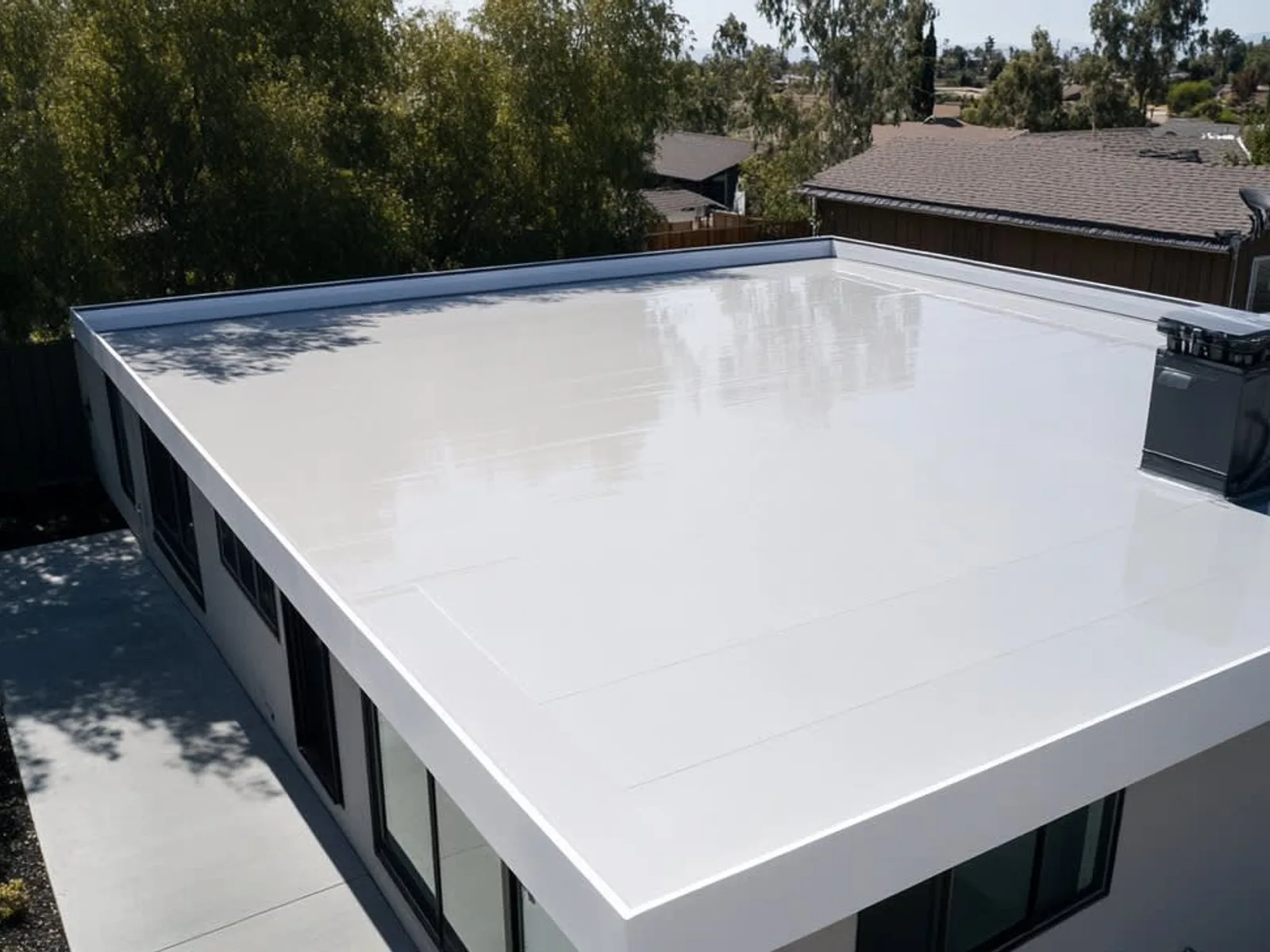
Heat-welded like TPO, but with a chemistry commonly selected where grease, oils, and certain chemical exposures would degrade other membranes. If your roof lives above a kitchen or a process floor, PVC is usually the conversation to have.
Licensed for commercial roofing in Mississippi
Southeast Roofing LLC holds Mississippi State Board of Contractors Commercial Certificate of Responsibility 27720-SC, alongside residential license R22245. Mississippi requires a commercial license for commercial jobs over $50,000. Below that, local city or county requirements may still apply.
Where PVC earns its premium
Every restaurant exhaust fan rains a fine mist of grease onto the roof around it, and grease degrades most membranes years ahead of schedule. PVC's chemistry resists that exposure far better than standard single-plies, which is why food service, kitchens, and processing facilities commonly spec PVC. Add hot-welded seams and strong reflectivity, and it's a premium membrane that earns its price on the right building.
PVC also carries one of the longest performance histories among weldable membranes. For buildings without chemical exposure, TPO usually pencils out better, and we'll tell you so. This is about matching chemistry to what your roof actually endures.
When PVC is the right spec
Restaurants & kitchens
Grease exhaust degrades ordinary membranes early, PVC is the standard answer.
Chemical or oil exposure
Process facilities with rooftop discharge need chemistry verified against the actual exposure.
Demanding service conditions
Welded seams and a flexible sheet handle hardworking, equipment-dense roofs well.
Reflectivity wanted
White PVC performs like other reflective membranes against Gulf-region cooling loads.
The chemistry, without the chemistry degree
PVC roofing is a reinforced thermoplastic: polyvinyl chloride compounded with plasticizers that keep the sheet flexible, built around a fabric scrim for strength. The vinyl formulation is what gives PVC its resistance to grease, oils, and a range of chemicals that soften or swell other single-ply membranes.
One important honesty note: 'chemical resistance' is not a blank check. Resistance varies by chemical, concentration, temperature, and the specific product: every major manufacturer publishes chemical-resistance documentation, and for a processing facility or unusual exposure we check the actual exposure against the actual documentation before recommending anything.
Common thicknesses: roughly 50, 60, and 80 mil
PVC is commonly offered in nominal thicknesses around 50, 60, and 80 mil (a mil is a thousandth of an inch), with exact figures varying by manufacturer and product line. As with any single-ply, the thickness above the reinforcing scrim is the membrane's weathering allowance, thicker sheets weather longer and typically qualify for longer warranty terms.
On high-exposure roofs, the very buildings that choose PVC, we lean toward the heavier end. A kitchen roof works harder than an office roof, and the increment for thicker membrane is small against the cost of replacing a degraded one early.
Seams fused by heat, checked by hand
Like other thermoplastics, PVC seams are hot-air welded. The sheet surfaces are melted together under heat and pressure so the joint cures into a continuous membrane rather than a glued lap. Completed seams get probed and verified following the manufacturer's procedures while the crew is still on the roof.
The welding requirement cuts both ways at repair time: PVC repairs must be made with PVC-compatible material, and PVC cannot be welded to TPO. The two chemistries look similar from a ladder but will not fuse. Knowing exactly which membrane is on your roof before anyone opens a repair kit is not optional.
Kitchens, exhaust fans, and the grease problem
Rooftop grease doesn't stay near the fan. It spreads with wind and rain across a wide zone, and on most membranes it slowly softens the surface until seams and details fail. PVC's resistance buys time, but membrane chemistry should be the second line of defense, not the first: exhaust-fan discharge should be managed with containment systems and regular service so the roof isn't the grease trap.
For restaurants, groceries, and food processing across South Mississippi, our usual pattern is PVC where exposure is real, honest containment detailing at the fans, and a maintenance cadence that keeps the exposure zones inspected. That combination is what actually gets these roofs to a full service life.
PVC or TPO. The decision most buildings face
For a building with no chemical or grease exposure, TPO usually wins on economics and does the reflective, welded-seam job well. Once exposure enters the picture, PVC's premium starts paying rent. The comparison below is the honest version.
| Attribute | PVC | TPO |
|---|---|---|
| Membrane type | Reinforced thermoplastic (vinyl-based) | Reinforced thermoplastic (polyolefin-based) |
| Seams | Hot-air welded | Hot-air welded |
| Grease & chemical exposure | Commonly selected, verify against manufacturer documentation | Generally not recommended for grease zones |
| Relative initial investment | Higher initial investment | Moderate initial investment |
| Field history | Long history among weldable membranes | Newer, now the most-installed low-slope system |
| Repair cross-compatibility | Not weld-compatible with TPO | Not weld-compatible with PVC |
Installing PVC over what's already there
PVC installs mechanically attached or fully adhered over a continuous substrate, like every membrane, it never spans open framing, and the insulation and cover board below it are specified as their own components. Over certain existing materials, PVC needs a separation layer: some substrates (including asphalt products and polystyrene insulations) can interact badly with the membrane, so compatibility drives the assembly design.
Drainage rules don't bend for premium membranes either. Ponding water is never harmless, and the design targets positive drainage, commonly around a quarter inch per foot where practical, with walk pads at serviced equipment so kitchen and HVAC techs aren't grinding grit into the sheet.
Our approach
How we install PVC
Exposure assessment
We map what the roof actually endures: exhaust, discharge, traffic, and spec accordingly.
Itemized proposal
Membrane, insulation, and detail package specified line by line against the alternatives.
Welded installation
Hot-air welded seams, reinforced details at curbs and penetrations, checked as we go.
Service planning
High-exposure roofs deserve scheduled checkups; we set the cadence with you.
Why PVC pricing is always building-specific
PVC projects vary more than most because exposure drives the spec. Here's what we evaluate before the proposal:
The exposure profile
Grease, oils, or chemicals on the roof, checked against manufacturer chemical-resistance documentation, set the membrane and detailing requirements.
Membrane thickness
Roughly 50, 60, or 80 mil nominal; high-exposure roofs usually justify the heavier sheet.
Separation layers
Some existing substrates require an isolation layer under PVC, which adds a component to the assembly.
Exhaust and grease management
Containment detailing at fans and discharge points is part of the scope on food-service roofs.
Tear-off vs. recover
Whether the existing roof can stay depends on moisture findings, compatibility, and code layer limits.
Curb and penetration count
Kitchen and process roofs are typically equipment-dense. Every curb is detailed by hand.
Attachment and wind requirements
Mechanically attached or fully adhered, matched to deck type and the building's uplift zone.
FAQ
PVC Roofing questions, answered
Why does PVC cost more than TPO?
Our restaurant roof keeps failing around the exhaust fans. Is that fixable?
Does PVC resist every chemical?
How long does PVC last?
Can PVC be welded to TPO?
Can PVC go directly over our old roof?
Industries we serve
Built for your kind of building
Every facility type has its own schedule, budget, and roof. We roof them all across South Mississippi.
Service area
Where we provide pvc roofing
Based in Hattiesburg, on commercial buildings across the Pine Belt, the Gulf Coast and the corridor between them.
We work well beyond these eight, on a radius of about two hours from Hattiesburg. See every town we serve, or tell us where the building is.
Let's talk about your roof
A consultation, not a sales pitch: we assess your building, your operations, and your budget cycle, then propose the system that actually fits.