
New service
Roof Washing for Homes in Hattiesburg, MS
Roof washing, handled by roofers first
Those black streaks aren't dirt. They're a living organism feeding on your shingles. We now offer residential roof washing across South Mississippi, and because we're a roofing company, the roof gets evaluated before anything touches it.
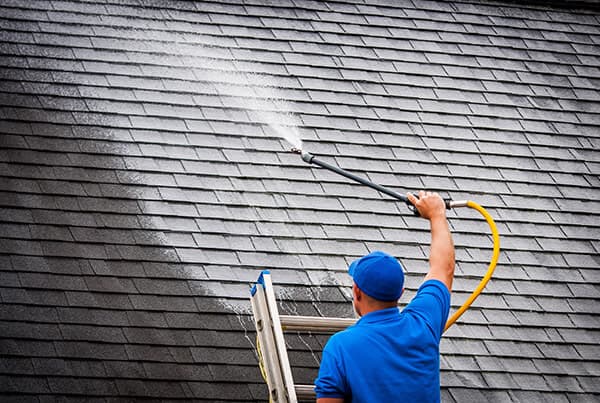 Residential roof washing
What those black streaks actually are
The dark streaks running down South Mississippi roofs are almost always algae, commonly Gloeocapsa magma, and it thrives in exactly what we have here: heat, humidity, shade, and long summers. It takes hold on the north- and shaded-facing slopes first, which is why one side of a roof can look years older than the other.
It matters beyond appearance. The organism feeds on limestone filler in asphalt shingles, holds moisture against the roof surface, and darkens the roof so it absorbs more heat. Moss and lichen are a further step: moss holds water like a sponge at the shingle edges, and lichen roots into the granule surface, so removing it badly does more damage than leaving it alone.
That's the whole reason we now offer this as a roofing service. A clean roof is a cosmetic result; a roof that's still intact afterward is a roofing outcome, and those two things are not automatic.
When a roof wash is worth doing
If you recognize two or more of these, it's worth having the roof looked at.
Black streaks running downslope
The classic algae signature, dark vertical staining that starts at the ridge and runs toward the eaves, usually worst on shaded slopes.
Green moss at the edges
Moss clumps along shingle edges and in valleys hold moisture against the roof and lift shingle edges over time.
One slope much darker than another
Uneven staining between a shaded north slope and a sunny south slope is a strong sign of biological growth rather than age.
You're selling or listing the house
Roof staining reads as a worn-out roof in listing photos and inspections, even when the shingles have years of service left.
Tree cover and constant shade
Overhanging limbs, pine straw accumulation, and shade keep the roof damp for longer, which is exactly the condition the organism wants.
Someone offered to pressure wash it
If a cleaning quote mentions high pressure on an asphalt roof, get a roofer's opinion before anyone starts. This is the one that costs people a roof.
Why pressure is the wrong tool on a shingle roof
Asphalt shingles protect themselves with a layer of ceramic-coated granules. Those granules are what block ultraviolet light and give the shingle its fire and weather performance, and they're held in an asphalt surface that softens in the heat. Force water at that surface under pressure and you strip granules off, drive water backward under the courses, and shorten the life of a roof that may have had a decade left.
This isn't a fringe opinion. Shingle manufacturers direct owners away from high-pressure washing in their care guidance, and roofs cleaned with pressure commonly show it afterward: bare patches, granules in the gutters, and accelerated aging on the slopes that were cleaned hardest. On metal, aggressive pressure and the wrong approach can drive water past laps and fasteners rather than over them.
So the questions we answer before scheduling any wash are roofing questions, not cleaning questions: what the roof covering actually is, what condition it's in, whether it's sound enough to be cleaned at all, and what method suits it. Some roofs shouldn't be washed, and if yours is one of them, we'll tell you that instead of selling you a wash.
| What we check | Why it decides the approach |
|---|---|
| Roof covering and age | Asphalt shingle, metal, and tile each behave differently, and an aging shingle roof may not be a candidate at all. |
| Granule condition | A roof already shedding granules has less to lose before it starts leaking, cleaning may not be the right spend. |
| Growth type and extent | Surface algae staining, thick moss, and rooted lichen are not the same problem and don't respond the same way. |
| Flashing, boots, and penetrations | Existing gaps are where water can be driven inside during any wash, so they get inspected first. |
| Slope, access, and surroundings | Pitch, height, and what sits below: landscaping, HVAC, walkways, shape how the work is staged. |
| Gutters and drainage | Everything rinsed off the roof ends up in the gutters, so their condition is part of the plan. |
Metal and tile roofs are a different job
Not every home in South Mississippi wears asphalt. Standing seam and exposed-fastener metal, and the tile roofs found on some coastal and Mediterranean-style homes, collect the same staining in the same climate, but none of them react to cleaning the way a shingle roof does. Treating all three the same way is how finishes get ruined and water ends up somewhere it was never meant to go.
On metal, the concern is direction and detail rather than granules. Panels are built to shed water one way, and laps, seams, and fastener penetrations are designed around water running that direction; forcing water uphill across a lap, or straight into an exposed fastener and its washer, works against the way the roof was assembled. The factory finish is its own consideration. It's the layer carrying the corrosion and color performance, and it isn't something to scour.
Tile brings a third set of problems. The tiles themselves are durable, but the underlayment beneath them is what actually keeps water out, and a tile roof walked carelessly cracks pieces that then have to be matched and replaced. Growth in the channels and along the laps is common and it is removable, but the roof has to be accessed and staged by someone who knows what tile will and won't take.
- Metal: water is kept moving with the panel, not driven back against laps, seams, or fasteners.
- Metal: the factory finish is treated as the protective layer it is, not as a surface to scrub down.
- Tile: the working assumption is that the underlayment below, not the tile, is the waterproofing.
- Tile: breakage is a real cost, so access and staging get settled before anyone steps on the roof.
- Any covering, if the evaluation says the roof shouldn't be washed, that's the answer you get.
Washing versus replacing: an honest answer
Washing does not add life to a roof that's finished. If the shingles are brittle, the granule loss is widespread, or the roof is near the end of its service life, cleaning buys appearance and not much else, and the money is usually better held for the replacement. We would rather say that out loud than take the job.
Where a wash genuinely earns its keep is a roof with real service life left that simply looks a decade older than it is: staining on the shaded slopes, moss starting in the valleys, sound shingles underneath. That roof is worth cleaning, and it's worth keeping clean, because the conditions that grew the algae the first time are still there afterward.
Between the two extremes, the honest answer depends on what the evaluation finds, which is why we look before quoting rather than pricing a wash off a photo.
Keeping it from coming back so fast
Regrowth is normal, and how fast it returns depends on the things around your roof more than on the roof itself. Shade is the biggest driver in our climate, followed by anything that keeps the surface damp: overhanging limbs, heavy pine straw, blocked gutters that back water onto the roof edge.
- Trim back limbs that shade or drop debris onto the roof, where it's safe to do so.
- Keep pine straw and leaf litter off the roof surface and out of the valleys.
- Keep gutters flowing so water leaves the roof edge instead of sitting at it.
- Address any attic ventilation problem: a hot, damp roof deck doesn't help.
- Have the roof looked at after major storms, when debris and damage arrive together.
Our approach
How a roof wash runs with us
Roof evaluation first
We inspect the roof covering, its condition, and the growth involved, and tell you plainly whether washing is the right call.
Scope in writing
You get the scope of what will be cleaned and how it will be staged: from Southeast Roofing, on our paperwork.
Scheduling through us
We coordinate the date with you and handle the communication in between, so there's one schedule and one number to call.
Property protection
Landscaping, walkways, and what sits below the work area are planned for before anyone starts.
The wash itself
Carried out with an approach matched to your roof covering and its condition, rather than one setting used on every roof.
Walkthrough and findings
We review the result with you and pass along anything the roof itself needs, repair or otherwise.
What we evaluate before quoting a roof wash
Roof washing isn't priced off square footage alone. These are the things that actually move a quote.
Roof size and pitch
Area sets the baseline; pitch changes how the work has to be staged and how long it takes.
Number of stories and access
Height, tight side yards, fences, and where equipment can sit all affect the approach.
Roof covering
Asphalt shingle, metal, and tile each call for a different approach, which changes the work involved.
Type and extent of growth
Light surface staining and heavy rooted moss are different jobs on the same size roof.
Roof condition
A roof with existing damage may need repairs handled first, or may not be a candidate for washing at all.
What sits below
Landscaping, decks, pools, HVAC units, and walkways all need protecting, which is part of the work.
Gutter condition
Everything rinsed off the roof reaches the gutters, so their state can add to the scope.
Storm damage? We speak insurance.
Thorough documentation, reports in the format adjusters expect, and someone on your side at the adjuster meeting.
How claim assistance works$0 down financing available
Apply through our partner GoodLeap in minutes and see the plans you qualify for, decide with real numbers in hand.
Explore financing optionsLifetime warranty
Manufacturer limited-lifetime warranty options are available on qualifying roofing systems. Ask what applies to your roof at your free inspection.
Start with a free inspectionFAQ
Roof Washing questions, answered
Will washing my roof damage the shingles?
What happens to my landscaping and everything below the roof?
Are those black streaks actually hurting my roof?
How long before the streaks come back?
My roof is old. Should I wash it or replace it?
Do you wash commercial roofs too?
Related services
You may also need
Roof Repair
If the evaluation turns up a leak source, this is where it gets fixed properly.
Learn moreSeamless Gutters
Everything rinsed off a roof ends up here, worth checking while we're on site.
Learn moreAsphalt Shingle Roofing
How shingle systems are built, and why the granule surface matters so much.
Learn more
Service area
Where we provide roof washing
Based in Hattiesburg and serving Mississippi within about two hours, from the Pine Belt to the Gulf Coast.
- Purvis
- Sumrall
- Seminary
- Collins
- Ellisville
- Richton
- Waynesboro
- Leakesville
- Columbia
- Poplarville
- Wiggins
- Perkinston
- Lucedale
- Kiln
- McHenry
- Saucier
- Diamondhead
- Bay St. Louis
- Pass Christian
- Long Beach
- D'Iberville
- Ocean Springs
- Moss Point
- Pascagoula
- Crystal Springs
- Jackson
- Meridian
Don't see your town? If you're within about two hours of Hattiesburg, we most likely serve you.
Ready for a roof you don't have to think about?
Schedule a free inspection or get an instant estimate right now. $0 down financing available through GoodLeap.