
New service
Commercial Roof Washing in Hattiesburg, MS
Commercial roof washing, coordinated by your roofer
Staining and growth on a commercial roof is a curb-appeal problem and a roofing question at the same time. We evaluate the system first, scope the work, and schedule it around how your building actually operates.
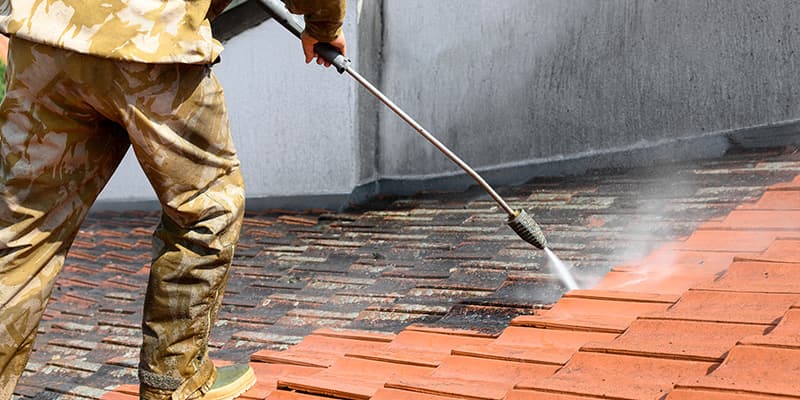 Commercial roof washing
Licensed for commercial roofing in Mississippi
Southeast Roofing LLC holds Mississippi State Board of Contractors Commercial Certificate of Responsibility 27720-SC, alongside residential license R22245. Mississippi requires a commercial license for commercial jobs over $50,000. Below that, local city or county requirements may still apply.
Why a stained commercial roof gets attention
On a commercial property, roof staining tends to surface for one of three reasons: a tenant or owner is unhappy with how the building shows, a property is being marketed or appraised, or someone noticed growth spreading and asked whether it's doing damage. All three are reasonable questions, and all three deserve a roofing answer rather than a cleaning pitch.
The complication is that commercial buildings rarely carry one roof. A single property can have low-slope membrane over the main structure, metal on canopies or a mansard, and shingles on an office wing, and those surfaces do not respond to cleaning the same way. What's safe on one can be the wrong call on the one beside it.
So the first step is establishing what's actually up there and what condition it's in. That's a roofing assessment, and it's the part a cleaning contractor working alone isn't positioned to make.
One property, several roof surfaces
Before any wash is scheduled, we identify each roof area on the property and treat them as separate decisions. A membrane roof raises questions about seams, terminations, drainage, and foot traffic. Metal raises questions about laps, fasteners, and finish. Shingled sections raise the granule question that drives every residential wash. Deciding all of that in one sweep is how buildings get damaged.
Two constants apply across all of them. First, anything rinsed off the roof has to go somewhere, so drains, scuppers, gutters, and what sits below the building line are part of the plan, not an afterthought. Second, existing openings are where water gets driven inside during any wash, so flashings, penetrations, and terminations get looked at before work starts rather than explained afterward.
| Roof surface | What we evaluate first | Why it changes the approach |
|---|---|---|
| Low-slope membrane | Seams, terminations, penetrations, drainage, traffic history | Cleaning is planned around watertight details and where water will actually run off. |
| Metal panels | Laps, fastener condition, finish, and slope | The wrong approach can drive water past laps and fasteners instead of over them. |
| Shingled sections | Granule condition, age, remaining service life | Same rule as a house: pressure strips the surface that protects the shingle. |
| Canopies and entries | Public access below and what's parked or planted underneath | These sit over doors and walkways, so staging and protection drive the schedule. |
Working around a building that stays open
Nobody closes a property for a roof wash, so the scheduling questions get settled before the date does: which entrances stay in use, where crews and equipment can stage, what sits under the work area, and whether the work needs to happen outside business hours. On tenant-occupied buildings, notice matters as much as the work itself, tenants who know what's happening don't call the office about it.
The same applies to what's below the roofline. Parking, landscaping, storefronts, patios, HVAC equipment, and pedestrian routes all need planning for, and on multi-building properties the work is commonly phased building by building rather than done all at once.
- Entrances, walkways, and parking areas planned around before scheduling.
- Tenant and staff notice coordinated ahead of the work.
- Landscaping, storefronts, and rooftop equipment protected as part of the scope.
- Multi-building properties phased rather than done in a single sweep.
- After-hours or weekend scheduling where the building's operation calls for it.
What a wash won't fix on a commercial roof
Cleaning changes how a roof looks. It does not change how a roof performs, and on commercial buildings those two things get confused often enough to be worth stating plainly. A membrane that has pulled at its terminations, seams that have opened, insulation that has taken on water under the deck, drains that have never carried the roof properly. A wash leaves every one of those exactly where it found them, just cleaner.
The distinction matters most when a property is being cleaned for a reason: a sale, an appraisal, a lender's inspection, a tenant complaint that finally reached the office. A roof that photographs well and still leaks hasn't solved the problem it was cleaned for. The assessment that comes with the wash is the part that tells you which of the two you actually have.
Where the assessment finds a roof that's sound but weathered, cleaning is a reasonable thing to spend money on and we'll do it. Where it finds a system near the end of its service life, restoration or replacement planning is the honest answer, and coating an aged roof is a different project with different economics from washing one, which is a conversation worth having before the budget cycle closes rather than after.
- Open seams, failed terminations, and lap problems are repair items, not cleaning items.
- Wet or saturated insulation is a system condition no surface wash can reach.
- Ponding and poor drainage return the moment the roof dries out.
- Staining on an otherwise sound roof is cosmetic, and wanting it gone is perfectly reasonable.
- A system near the end of its life is better served by a restoration or replacement plan.
Our approach
How a commercial wash is coordinated
Property walk and roof assessment
We identify each roof area, its system, and its condition, and flag anything that needs attention before cleaning is considered.
Scope by roof area
You get a written scope that treats each surface on its own terms rather than one blanket line item.
Operations planning
Access, staging, tenant notice, entrances, and hours are settled with your team before a date is set.
Protection and staging
Landscaping, storefronts, walkways, and rooftop equipment are planned for as part of the work.
The wash
Carried out surface by surface, matched to each roof area on the property rather than one method run across the whole building.
Documentation and findings
We report the result and any roofing issues the assessment surfaced, so they can be planned and budgeted.
What determines a commercial roof-washing proposal
Commercial washing is scoped by property, not by a rate card. Here's what actually shapes it.
Roof areas and systems involved
A property with membrane, metal, and shingled sections is several jobs, not one.
Building height and access
How crews and equipment reach each roof area drives much of the labor.
Extent and type of growth
Light staining and heavy established growth are different amounts of work on identical square footage.
Roof condition
Existing seam, flashing, or drainage problems may need addressing before any cleaning is appropriate.
Operating restrictions
After-hours work, phased buildings, and tenant coordination all affect how the project is staged.
Protection requirements
Storefronts, landscaping, parking, and rooftop equipment below the work area are part of the scope.
Drainage and runoff handling
Where rinse water goes, and the condition of the drains and gutters carrying it, factors into planning.
FAQ
Commercial Roof Washing questions, answered
How often does a commercial roof need washing?
Our property has several different roof types. Is that a problem?
Can the work happen without disrupting our tenants?
What if the assessment finds something wrong with the roof?
Is washing ever the wrong call on a commercial roof?
Related services
You may also need
Industries we serve
Built for your kind of building
Every facility type has its own schedule, budget, and roof. We roof them all across South Mississippi.
Service area
Where we provide commercial roof washing
Based in Hattiesburg, on commercial buildings across the Pine Belt, the Gulf Coast and the corridor between them.
We work well beyond these eight, on a radius of about two hours from Hattiesburg. See every town we serve, or tell us where the building is.
Let's talk about your roof
A consultation, not a sales pitch: we assess your building, your operations, and your budget cycle, then propose the system that actually fits.